
The Origins of Human Evolution
The story of human evolution is not merely a biological timeline but a grand epic of survival, adaptation, and cognitive breakthroughs. Millions of years ago, in the vast landscapes of Africa, our ancestors began a journey that would eventually lead to the mastery of the entire planet. This process of human evolution was triggered by environmental shifts, forcing early primates to leave the safety of the trees and venture into the open savannas. The transition to bipedalism—walking on two legs—was the first critical “hardware upgrade” in our history, allowing our ancestors to carry tools and food over long distances.
The Cognitive Revolution and Tool Use
As we delve deeper into the mechanics of human evolution, we see the emergence of the genus Homo. With larger brains and refined motor skills, species like Homo habilis and Homo erectus began to manipulate their environment. The mastery of fire and the creation of sophisticated stone tools were significant milestones in human evolution. These innovations allowed for a higher-protein diet, which in turn fueled further brain growth. It was during this era that the foundations of social cooperation and communication were laid, setting the stage for the complex societies we live in today.
Modern Humans and the Agricultural Shift
About 300,000 years ago, Homo sapiens emerged as the definitive product of human evolution. Our species possessed an unprecedented capacity for symbolic thought and language. This “software update” allowed humans to share complex ideas and myths, leading to the Agricultural Revolution. Instead of moving with the seasons, humans began to settle, domesticate animals, and grow crops. While this shifted the physical trajectory of human evolution, it accelerated our cultural and technological development at an exponential rate, leading to the rise of great civilizations and empires.
The Digital Frontier: From Biological to Artificial
Human Evolution: From Primate Origins to an AI-Enhanced Future
The story of human evolution is one of the most remarkable journeys in the history of life on Earth. It is a story not only of biological change, but also of intelligence, creativity, survival, and adaptation. From early primates moving through ancient forests to modern humans building digital civilizations, human evolution has always been driven by the need to respond to a changing world.
When people hear the phrase human evolution, they often think of fossils, stone tools, and prehistoric ancestors. These are indeed important parts of the story. Early human ancestors developed upright walking, improved hand coordination, and the ability to use tools in increasingly sophisticated ways. These changes may seem simple compared to modern technology, but they marked turning points in human evolution. Each adaptation helped our ancestors survive new climates, find food more efficiently, and cooperate in larger social groups.
Over time, human evolution became more than a biological process. The human brain grew in complexity, language emerged, and culture began to shape survival as much as genetics did. Unlike other species, humans learned not only through instinct, but through teaching, storytelling, and shared knowledge. This ability to pass information from one generation to the next accelerated human evolution in a unique way. Human beings did not just adapt physically; they adapted intellectually and socially.
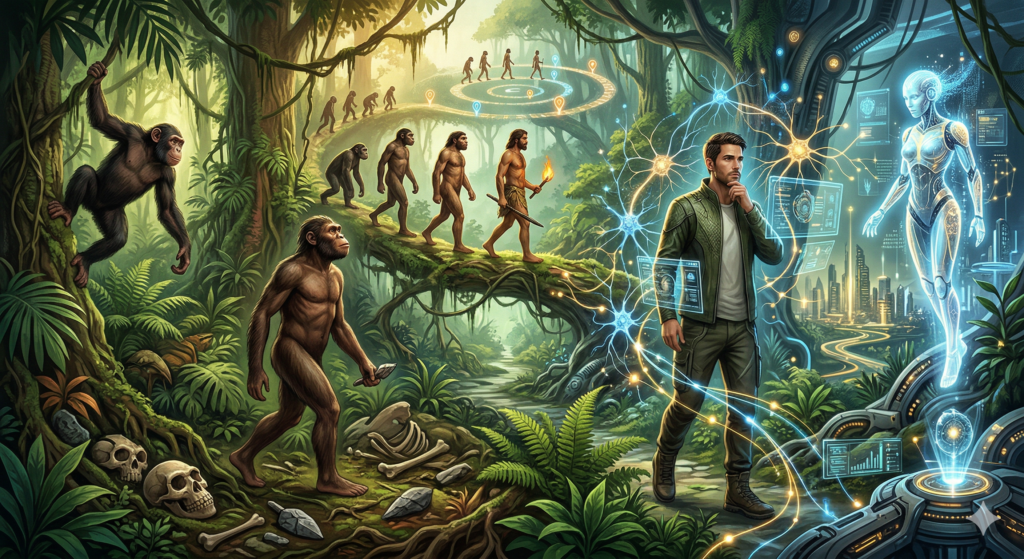
This long history of transformation has now brought us to a new stage in our development. In the modern world, humans are no longer limited to natural tools and physical environments. We live in an age of global communication, biomedical innovation, machine learning, and space exploration. The connection between humanity and technology has become so strong that many thinkers now see it as the defining feature of the next phase of our species’ journey. This shift suggests that our future is shaped not only by nature, but also by the tools we create.
Artificial Intelligence stands at the center of this transformation. AI is changing the way humans work, communicate, learn, and make decisions. It is already influencing industries, education, healthcare, and creativity. As this technology advances, it raises a profound possibility: that the next stage of our development may involve not only natural selection, but intentional enhancement. In other words, humanity may begin shaping its own path in ways previous generations could barely imagine. For many observers, this could become one of the most significant turning points in our history.
Some futurists and transhumanist thinkers argue that the next era will be defined by a synthesis of biology and machine. In this vision, AI will not remain an external tool. Instead, it may become deeply integrated into human life through neural interfaces, cognitive enhancement, and intelligent systems that expand memory, reasoning, and perception. If that happens, the boundaries between human capability and technological capability may become increasingly blurred.
Of course, this future also brings serious questions. If AI becomes a partner in thought itself, what will it mean to be human? Will this new phase create greater wisdom, health, and opportunity, or will it deepen inequality and dependence? These are not only scientific questions, but ethical and philosophical ones as well. What comes next will depend not just on what technology can do, but on how humanity chooses to use it.
At Apes of Eden, we believe that understanding the origins of human evolution is essential for understanding its future. By studying our primate ancestors, ancient environments, and early survival strategies, we gain perspective on the forces that shaped us. And by exploring AI, digital systems, and emerging human-machine relationships, we begin to see how human evolution may continue in the centuries ahead.
From the earliest apes to the rise of intelligent machines, the central theme of human evolution has always been adaptation. Humanity has survived and advanced by learning, changing, and reimagining what is possible. That journey is still unfolding today.
Understanding human evolution is essential for navigating the challenges of the 21st century. At Apes of Eden, we believe that by looking back at our primate roots, we can better prepare for the high-tech future ahead. Whether we are exploring ancient fossils or the rise of artificial intelligence, the central idea of human evolution remains the same: the constant drive to adapt, innovate, and survive. The story of human evolution is far from finished. In fact, as humanity moves closer to AI integration, the next stage of human evolution may become the most transformative chapter yet.
